Now Easy EMI available on astronomy products in india
Guaranteed safe & secure checkout
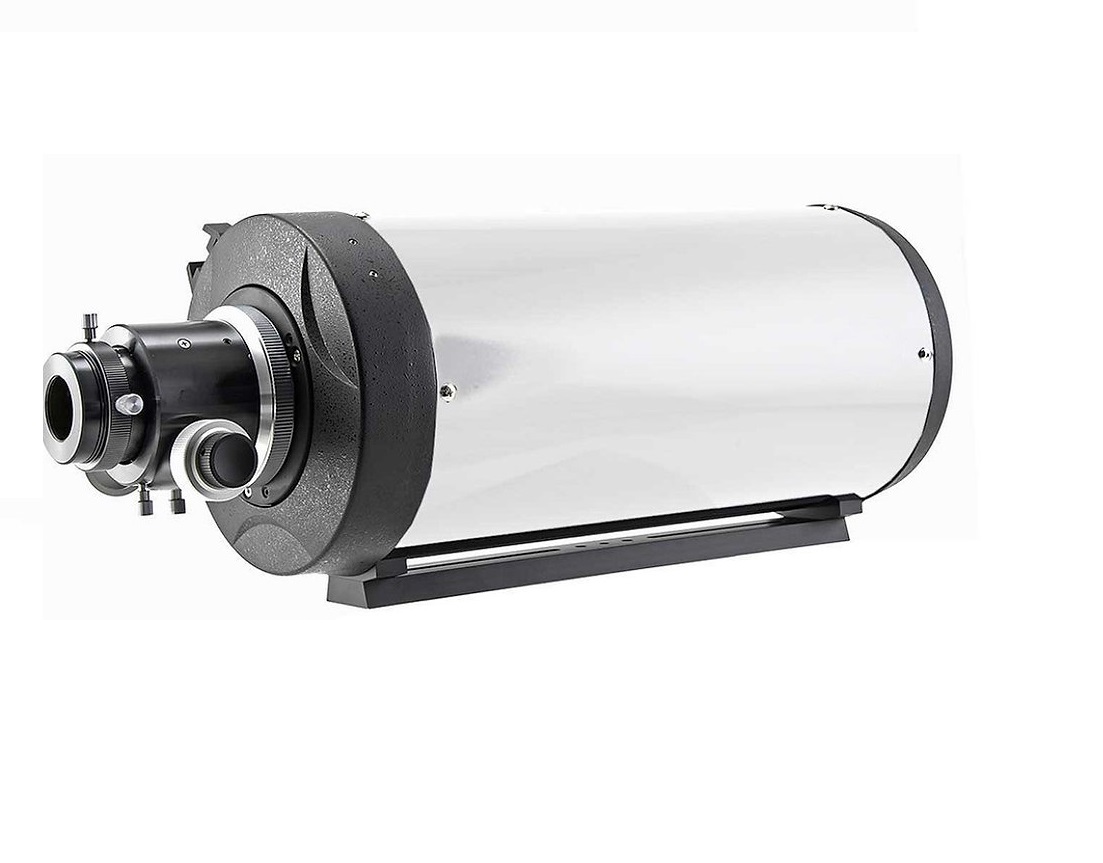
GSO 6″ F/9 Ritchey-Chretien Telescope
6″ F/9 RC Astrograph Telescope is not only perfect for Astrophotography but also for observing. It is extremely portable and offers a superb image quality and visual observing power too.
Advantages of RC Telescopes compared to MAC and SCT
Aperture 6″ / 152mm…….Focal Length 1370mm
f/9 is faster than a 6″ SC or Mak
illuminated field is much bigger
you can attach 2″ eyepieces and full size SLR/DSLR cameras without vignetting
two hyperboloidical mirrors with 96% reflectivity lead to a bright image
faster cool-down time and no dew problems because of open tube design without front correcting plate
enough back focus for all kinds of accessories
M90 extension tubes for easy reaching of the focus are optional. Spacer, to be placed between focuser and telescope
fixed mirrors and 2″ Crayford focuser with 1:10 dual speed transmission – no problems with mirror shift
corrected field is much bigger compared with a 6″ SC
Computer optimized internal baffle system
Optical design
True Ritchey-Chrétien two-mirror Cassegrain optics, with hyperbolic primary and secondary mirrors. 6″ aperture, 1370mm focal length, f/9 focal ratio. For more details, click on the “optics” icon above.
Hyperboloid Primary Mirror
Made of BK-7 optical glass. Polished to diffraction-limited or better surface accuracy. Unlike catadioptric designs (SCTs, Maksutovs, etc.) that move the primary mirror to focus (which can lead to image shift as the mirror moves), the GSO RC mirror is fixed to eliminate potential image shift. The fixed primary mirror also eliminates the frequent primary mirror collimation requirements of a Newtonian reflector.
GSO RC fixed primary and secondary mirrors “eliminate image shift, which has been the bane of Cassegrain scopes with moving-mirror focusing systems . . . It also keeps the effective focal length of the system constant, and the infinity focal point remains at a fixed point outside of the telescope, neither of which is the case with moving-mirror systems that change the separation between a Cassegrain’s primary and secondary mirrors.”
Hyperboloid Secondary Mirror
Made of BK-7 optical glass. Polished to diffraction-limited or better surface accuracy. Mounted in a four-vane spider and fully collimatable.
Enhanced aluminum optical coatings
Both primary and secondary mirrors have enhanced aluminum mirror coatings, overcoated with a protective layer of quartz for long life. Reflectivity is in the 96% range, the same as the larger multi-thousand dollar R-C scopes.
Optical tube
Painted rolled steel, 7.5″ o.d. x 19.25″ long, with die-cast and machined aluminum front and rear cells.
Internal light baffles
Computer optimized primary and secondary baffling. Eight contrast-enhancing glare-stop baffles in the optical tube, multiple glare-stop microbaffles in the secondary mirror light shield, and four baffles in the primary mirror baffle tube provide truly dark sky backgrounds during imaging.
Dual-speed Crayford focuser
A 2″ Crayford focuser is threaded onto the 90mm x 1mm pitch rear cell of the 6RC. The non-vignetting focuser has dual-speed focusing. There are two coarse focusing knobs. The right knob also has a smaller concentric knob with a 10:1 reduction gear microfine focusing ratio. This provides exceptionally precise image control during critical CCD imaging. All focus knobs are ribbed, so they are easy to operate, even while wearing gloves or mittens in cold weather.
Focuser travel
Focuser drawtube travel is 34mm, while back focus between the focuser’s 2″ accessory holder and the focal plane is 150mm. The 6RC falls 9-3/4″ outside the back of the telescope, allowing plenty of room for all types of cameras, filter wheels, and ancillary equipment.”
Extension Rings
Two extension rings (one 1″ and one 2″) are optional to thread onto the rear of the scope (singly or in combination) between the scope rear cell and the focuser. These form a very rigid and tilt-free extension that moves the focuser out from the rear cell to accommodate the varying back-focus requirements of webcam/Deep Sky Imager-type cameras versus DSLRs. Typically, both rings (one 1″ and one 2″) will properly position most DSLRs at the 6RC focal plane. The “1- and 2-inch extensions, as well as conventional extension tubes that fit in the 2-inch focuser, mean that you can always assemble the system so it comes to focus with whatever camera and accessories you’re using.”
For even more impressive coma-free DSLR imaging with the GSO-6RC, consider adding field flattener. This modestly-priced imaging accessory essentially eliminates the residual field curvature inherent in all reflector telescope designs, so that the coma-free star images remain point-like all across the field of the APS-C size imaging chip used in most DSLR cameras. Use of field flattener with a DSLR will typically requires one optional 2″ extension ring, instead of the two rings generally needed with a DSLR camera alone.
Compression ring accessory holders
The focuser drawtube ends in a 2″ accessory holder that uses a non-marring soft brass compression ring to hold 2″ imaging accessories in place. The compression ring won’t scratch the barrel of your accessories as an ordinary thumbscrew can. Also supplied is a 1.25″ accessory holder that slips into the 2″ compression ring holder to let you use 1.25″ imaging accessories. Like the 2″ eyepiece holder on the eyepiece holder rotation mechanism, the 1.25″ adapter also uses a non-marring soft brass compression ring.
Mounting dovetail
Vixen-style dovetail bar runs the length of the underside of the optical tube. The dovetail can be removed, if desired, so the 6RC can be installed in optional user-supplied mounting rings for piggyback mounting on a larger scope.
Finderscope dovetail
A Vixen-style finderscope bracket dovetail base is installed on the upper left side of the optical tube. It can easily be removed if not needed. It will accept Vixen-style finderscope brackets as well as red dot-type finders.
TECHNICAL SPECIFICATION
+
SPECIFICATIONS
DETAILS
Product Name
RC 6″ f/9 Ritchey-Chrétien Telescope
Country of Manufacture
Taiwan
Best for Viewing
Bright Deep Sky
Best for Imaging
Deep Sky
Astro-Imaging Capability
Lunar, Planetary & Long Exposure
Optical Design
Ritchey-Chrétien with Hyperbolic Primary & Secondary Mirror
Primary Mirror Diameter
152 mm (Quartz Glass, 96% Reflectivity, Dielectric Coating, 1/12th Wave)
Focal Length
1370 mm
Focal Ratio
f/9
Optical Type
Hyperbolic
Eyepiece Compatibility
50.8 mm (2″) & 31.7 mm (1.25″)
Resolving Power
0.76 arc sec
Limiting Stellar Magnitude
13.6
Optical Quality
Diffraction Limited
Focuser
Dual-Speed 1:10 Crayford, Image-Shift Free, 5 kg Load Capacity
Standard Eyepiece(s)
Not Included
Finderscope
Not Included
Star Diagonal
Not Included
Baffle System
Computer-Optimized for Stray Light Suppression
Tube Material
Aluminum
Tube Length
19.1″
Tube Diameter
191 mm
Weight (Optical Tube)
5.5 kg
Other Features
Vixen-Style Dovetail Bar, 360° Rotating Camera Angle Adjustment Collar
COLOUR
White
APERTURE
Between 100mm to 200mm Aperture
APERTURE(MM)
150
BEST USE
Guiding & Planetary Imaging
BRAND
GSO
COUNTRY OF ORIGIN
Taiwan
FOCAL LENGTH
Between 1000mm to 1500mm
FOCAL LENGTH(MM)
1370
FOCAL RATIO FN
9
IN THE BOX
Ritchey-Chretien optical tube assembly with 6” f/9 primary mirror | Dual speed 2″ Crayford-style focuser with | 1.25″ eyepiece adapter | Vixen-style dovetail rail | 1×2″ and 2×1” extension rings | Vixen-style finder base (finder not included) | Front dust cover

 Catadioptric Telescopes | Shop at Vorion Scientific India" class="zoom" data-magnify-src="https://www.vorionscientific.com/content/product/1761981157.jpg" style="height:100%;">
 Catadioptric Telescopes | Shop at Vorion Scientific India" class="zoom" data-magnify-src="https://www.vorionscientific.com/content/product/GSO-6-F9-Ritchey-Chretien-Telescope1.jpg" style="height:100%;">
 Catadioptric Telescopes | Shop at Vorion Scientific India" style="max-height:400px">
 Catadioptric Telescopes | Shop at Vorion Scientific India" style="max-height:400px">